
Convolution based time series classification in aeon
This notebook is a high level introduction to using and configuring convolution based classifiers in aeon. Convolution based classifiers are based on the ROCKET transform [1] and the subsequent extensions MiniROCKET [2], MultiROCKET [3] and HYDRA [4]. These transforms can be used in pipelines, but we provide convolution based classifiers based on ROCKET variants for ease of use and reproducibility. These are the RocketClassifier, MiniRocketClassifier, MultiRocketClassifier, MultiRocketHydraClassifier (a combination of MultiRocket and Hydra described in [4]) and the Arsenal, an ensemble of ROCKET classifiers. The RocketClassifier combines the ROCKET transform with a scikit-learn RidgeClassifierCV classifier, while Hydra and MultiRocketHydra further extend this approach by enhancing feature extraction and handling multiple feature maps more effectively. They can be configured to use other scikit-learn classifiers. The term convolution and kernel are used interchangeably in this notebook. A convolution is a subseries that is used to create features for a time series. To do this, a convolution is run along a series, and the dot product is calculated. This creates a new series (often called an activation map or feature map) where large values correspond to a close correlation to the convolution.
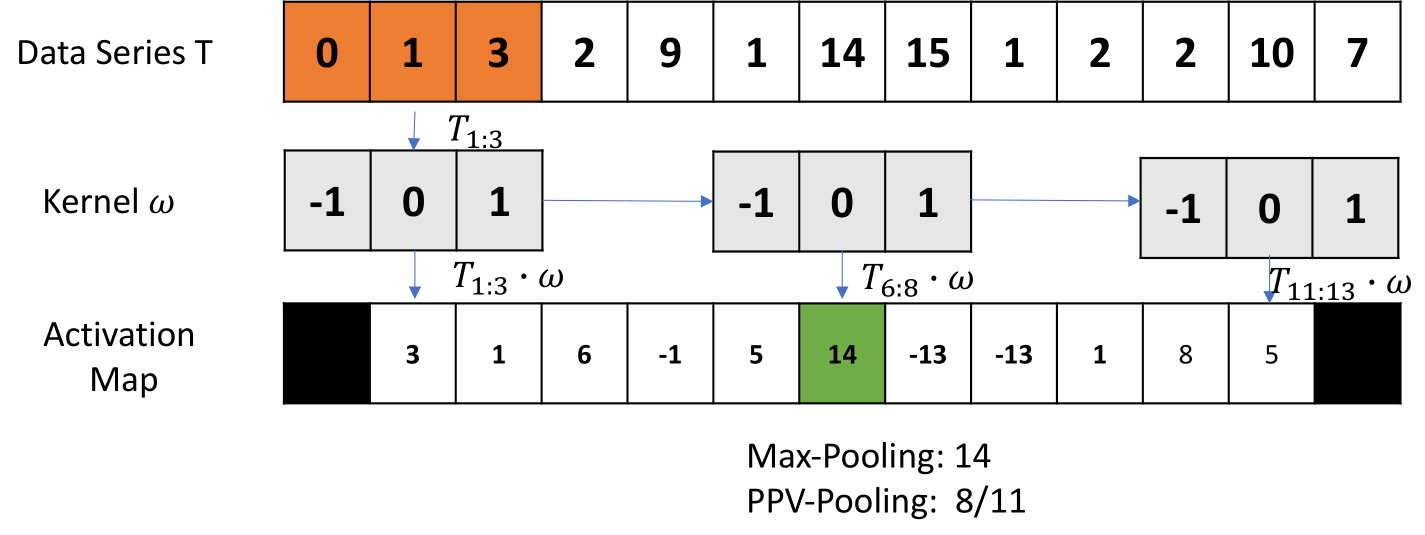
ROCKET computes two features from the resulting feature maps: the maximum value (sometimes called a max pooling operation), and the proportion of positive values (or ppv). In the above example the first entry of the activation map is the result of a dot-product between \(T_{1:3} * \omega = T_{1:3} \cdot \omega = 0 + 0 + 3 = 3\). Max pooling extracts the maximum from the activation map as feature. The proportion of positive values (PPV) is \(8 / 11\) in this example.
A large number of random convolutions are generated, and the two features are combined to produce a transformed train data set. This is used to train a linear classifier. [1] recommend a RIDGE Regression Classifier using cross-validation to train the \(L_2\)-regularisation parameter \(\alpha\). A logistic regression classifier is suggested as a replacement for larger datasets. 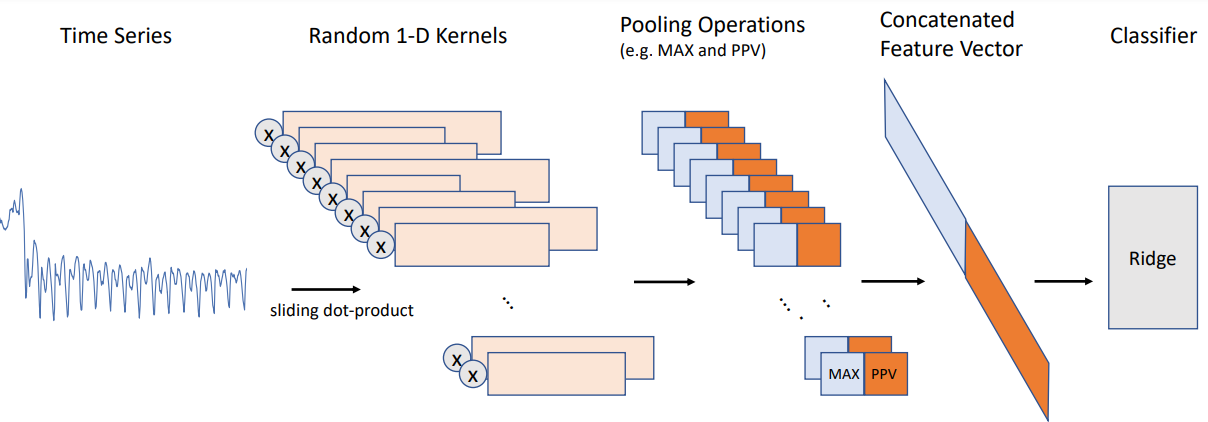
ROCKET employs dilation. Dilation is a form of down sampling, in that it defines spaces between time points. Hence, a convolution with dilation \(d\) is compared to time points \(d\) steps apart when calculating the distance.
[1]:
import warnings

from aeon.utils.discovery import all_estimators

warnings.filterwarnings("ignore")
all_estimators("classifier", tag_filter={"algorithm_type": "convolution"})
[1]:
[('Arsenal', aeon.classification.convolution_based._arsenal.Arsenal),
 ('HydraClassifier',
  aeon.classification.convolution_based._hydra.HydraClassifier),
 ('MiniRocketClassifier',
  aeon.classification.convolution_based._minirocket.MiniRocketClassifier),
 ('MultiRocketClassifier',
  aeon.classification.convolution_based._multirocket.MultiRocketClassifier),
 ('MultiRocketHydraClassifier',
  aeon.classification.convolution_based._mr_hydra.MultiRocketHydraClassifier),
 ('RocketClassifier',
  aeon.classification.convolution_based._rocket.RocketClassifier)]
[2]:
from sklearn.metrics import accuracy_score

from aeon.classification.convolution_based import (
    Arsenal,
    HydraClassifier,
    MiniRocketClassifier,
    MultiRocketClassifier,
    MultiRocketHydraClassifier,
    RocketClassifier,
)
from aeon.datasets import load_basic_motions  # multivariate dataset
from aeon.datasets import load_italy_power_demand  # univariate dataset

italy, italy_labels = load_italy_power_demand(split="train")
italy_test, italy_test_labels = load_italy_power_demand(split="test")
motions, motions_labels = load_basic_motions(split="train")
motions_test, motions_test_labels = load_basic_motions(split="test")
italy.shape
[2]:
(67, 1, 24)
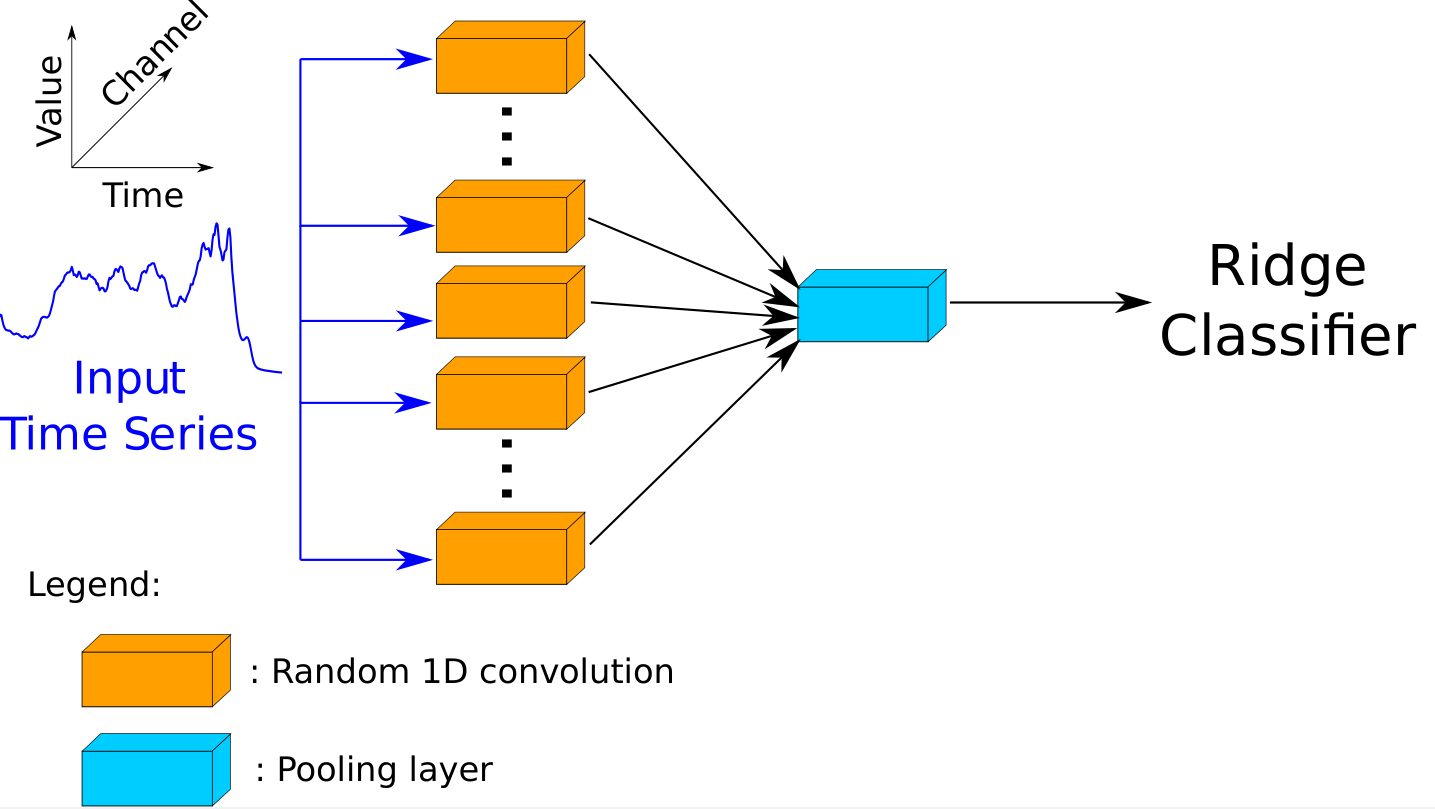
The ROCKET transform compiles on import via numba, which may take a few seconds. RocketClassifier does not produce estimates of class probabilities. Because of this, the Arsenal was developed to use with the HIVE-COTE meta-ensemble (in the hybrid package). The Arsenal is an ensemble of RocketClassifier estimators that is no more accurate than RocketClassifier, but gives better probability estimates.
[3]:
rocket = RocketClassifier()
rocket.fit(italy, italy_labels)
y_pred = rocket.predict(italy_test)
accuracy_score(italy_test_labels, y_pred)
[3]:
0.9708454810495627
[4]:
afc = Arsenal()
afc.fit(italy, italy_labels)
y_pred = afc.predict(italy_test)
accuracy_score(italy_test_labels, y_pred)
[4]:
0.967930029154519
The MiniRocketClassifier [2] uses the MiniRocket transform, a fast version of Rocket that uses hard coded convolutions and only uses PPV. MultiROCKET [3] adds three new pooling operations extracted from each kernel: mean of positive values (MPV), mean of indices of positive values (MIPV) and longest stretch of positive values (LSPV). MultiRocket generates a total of 50k features from 10k kernels and 5 pooling operations. It also extracts features from first order differences.
There are separate classifiers for MiniRocket and MultiRocket. The Arsenal can be configured to use the MiniRocket or MultiRocket by setting the rocket_transform parameter to “minirocket” or “multirocket”. Both work on multivariate series.
[5]:
multi_arsenal = Arsenal(rocket_transform="multirocket")
multi_arsenal.fit(italy, italy_labels)
y_pred = multi_arsenal.predict(italy_test)
accuracy_score(italy_test_labels, y_pred)
[5]:
0.9698736637512148
[6]:
mini_r = MiniRocketClassifier(n_kernels=100)
multi_r = MultiRocketClassifier(n_kernels=100)
mini_r.fit(motions, motions_labels)
y_pred = mini_r.predict(motions_test)
print(" mini acc =", accuracy_score(motions_test_labels, y_pred))
multi_r.fit(motions, motions_labels)
y_pred = multi_r.predict(motions_test)
print(" multi acc =", accuracy_score(motions_test_labels, y_pred))
 mini acc = 1.0
 multi acc = 1.0
The HYDRA transform [4] (for HYbrid Dictionary-Rocket Architecture) is a dictionary method for time series classification using competing convolutional kernels, incorporating aspects of both Rocket and conventional dictionary methods. Hydra involves transforming the input time series using a set of random convolutional kernels, arranged into g groups with k kernels per group, and then at each timepoint counting the kernels representing the closest match with the input time series for
each group.
[7]:
hydra_clf = HydraClassifier()
hydra_clf.fit(italy, italy_labels)
y_pred = hydra_clf.predict(italy_test)
accuracy_score(italy_test_labels, y_pred)
[7]:
0.966958211856171
MultiRocketHydra concatenates the results of the Hydra and MultiRocket transform and trains RidgeClassifierCV on the combined features.
[8]:
mr_hydra = MultiRocketHydraClassifier()
mr_hydra.fit(italy, italy_labels)
y_pred = mr_hydra.predict(italy_test)
accuracy_score(italy_test_labels, y_pred)
[8]:
0.9689018464528668
Convolutional classifiers have three other parameters that may affect performance. n_kernels (default 10,000) determines the number of convolutions/kernels generated and will influence the memory usage. max_dilations_per_kernel (default=32) and n_features_per_kernel (default=4) are used in ‘MiniROCKET’ and ‘MultiROCKET’. For each candidate convolution, max_dilations_per_kernel are assessed and n_features_per_kernel are retained.
Performance on the UCR univariate datasets
You can find the convolution based classifiers as follows
[9]:
from aeon.utils.discovery import all_estimators

est = all_estimators("classifier", tag_filter={"algorithm_type": "convolution"})
for c in est:
    print(c)
('Arsenal', <class 'aeon.classification.convolution_based._arsenal.Arsenal'>)
('HydraClassifier', <class 'aeon.classification.convolution_based._hydra.HydraClassifier'>)
('MiniRocketClassifier', <class 'aeon.classification.convolution_based._minirocket.MiniRocketClassifier'>)
('MultiRocketClassifier', <class 'aeon.classification.convolution_based._multirocket.MultiRocketClassifier'>)
('MultiRocketHydraClassifier', <class 'aeon.classification.convolution_based._mr_hydra.MultiRocketHydraClassifier'>)
('RocketClassifier', <class 'aeon.classification.convolution_based._rocket.RocketClassifier'>)
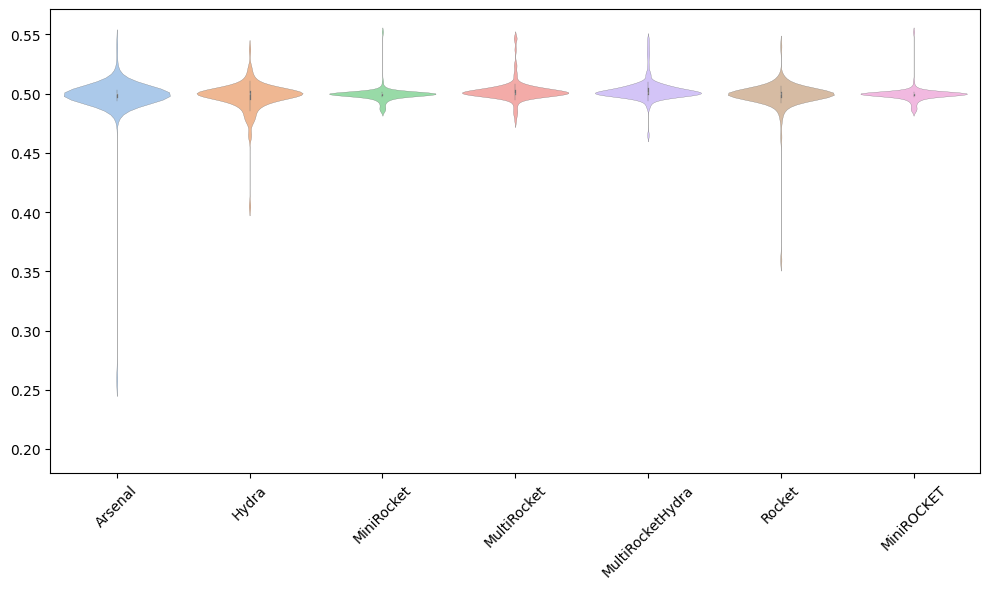
We can recover the results and compare the classifier performance as follows:
[10]:
from aeon.benchmarking.results_loaders import get_estimator_results_as_array
from aeon.datasets.tsc_datasets import univariate

names = [t[0].replace("Classifier", "") for t in est]
names.append("MiniROCKET")  # Alternatve configuration of the RocketClassifier
results, present_names = get_estimator_results_as_array(
    names, univariate, include_missing=False
)
results.shape
[10]:
(112, 7)
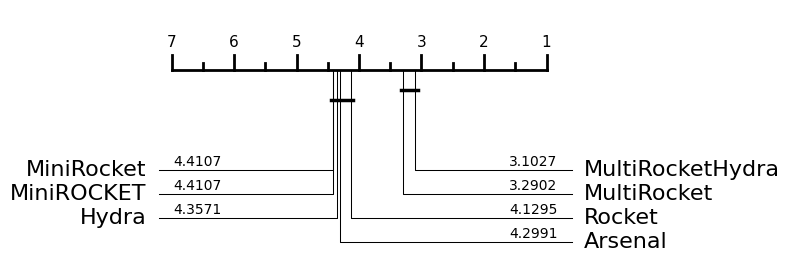
[11]:
from aeon.visualisation import plot_boxplot, plot_critical_difference

plot_critical_difference(results, names)
[11]:
(<Figure size 600x260 with 1 Axes>, <Axes: >)
[12]:
plot_boxplot(results, names, relative=True)
[12]:
(<Figure size 1000x600 with 1 Axes>, <Axes: >)
References
[1] Dempster A, Petitjean F and Webb GI (2019) ROCKET: Exceptionally fast and accurate time series classification using random convolutional kernels. arXiv:1910.13051, Journal Paper
[2] Dempster A, Schmidt D and Webb G (2021) MINIROCKET: A Very Fast (Almost) Deterministic Transform for Time Series Classification arXiv:2012.08791 Conference Paper
[3] Cahng Wei T, Dempster A, Bergmeir C and Webb G (2022) MultiRocket: multiple pooling operators and transformations for fast and effective time series classification Journal Paper
[4] Dempster, A., Schmidt, D.F. and Webb, G.I. (2023) Hydra: Competing convolutional kernels for fast and accurate time series classification. arXiv:2203.13652, Journal Paper
[ ]:
Generated using nbsphinx. The Jupyter notebook can be found here.